Dubai, United Arab Emirates
Made for life under the sun Ask the assistant عربي Trade & Specifier
Home/Resources
Resources

Better decisions begin with better understanding.

Outdoor structures are usually bought as products. They behave like infrastructure. What the right decision looks like depends on how the space is used, how long the structure needs to last, what the environment does to it, who maintains it, and what happens if it fails.

Read the guides, or ask a specific question. Both are free, and neither asks for your details.

Path one

Read and explore

For when you want to understand the subject properly.

Four guides covering buying decisions, procurement and RFQs, materials, and maintenance across the whole life of a structure. Written in plain language, for the person paying rather than the person calculating.

Explore the guides
Path two

Ask a specific question

For when you already know what you need to understand.

Ask about your project, an existing structure, materials, maintenance, or the options you are weighing up. The assistant answers from these same resources.

Read when you want depth. Ask when you need clarity.

Where to start

What would you like to understand?

Five situations that cover most of the reasons people arrive here. Each one has something to read and something to ask.

01

I am thinking about adding a structure

Whether you need one at all, what it will cost you over its life, and what to settle before anyone quotes.

02

I am choosing between materials or options

Steel, aluminium, membranes and coatings — and why your location decides more of it than your budget does.

03

I am preparing an RFQ or comparing proposals

What belongs in the document, and why three prices for the same structure usually are not for the same structure.

04

I already have a structure to look after

What it needs, how often, what a visit should contain, and what a record is worth when you come to sell or audit.

05

Something is wrong with an existing structure

Whether what you are looking at is cosmetic or structural, and whether it is a repair, a refurbishment or a replacement.

Knowledge library

Four guides. All free, none gated.

Written for the person paying rather than the person calculating. What each one contains is set out below, so you can tell now whether the one you need is worth waiting for.

01
ZIL Shades Material Guide

General public buying guide

For homeowners, tenants and property owners

A practical guide to thinking through comfort, ownership, approvals, budget, permanence and long-term value before adding an outdoor structure. It starts with the question most guides skip: whether you need one at all.

  • Do you actually need a structure, and what for
  • Owned, rented or managed property — and what changes
  • Temporary, relocatable or permanent
  • Approvals, community rules and who obtains them
  • Where the money genuinely goes
  • What happens after installation, and who pays for it

Want to understand the materials behind these options? Material guide →

02
ZIL Shades Material Guide

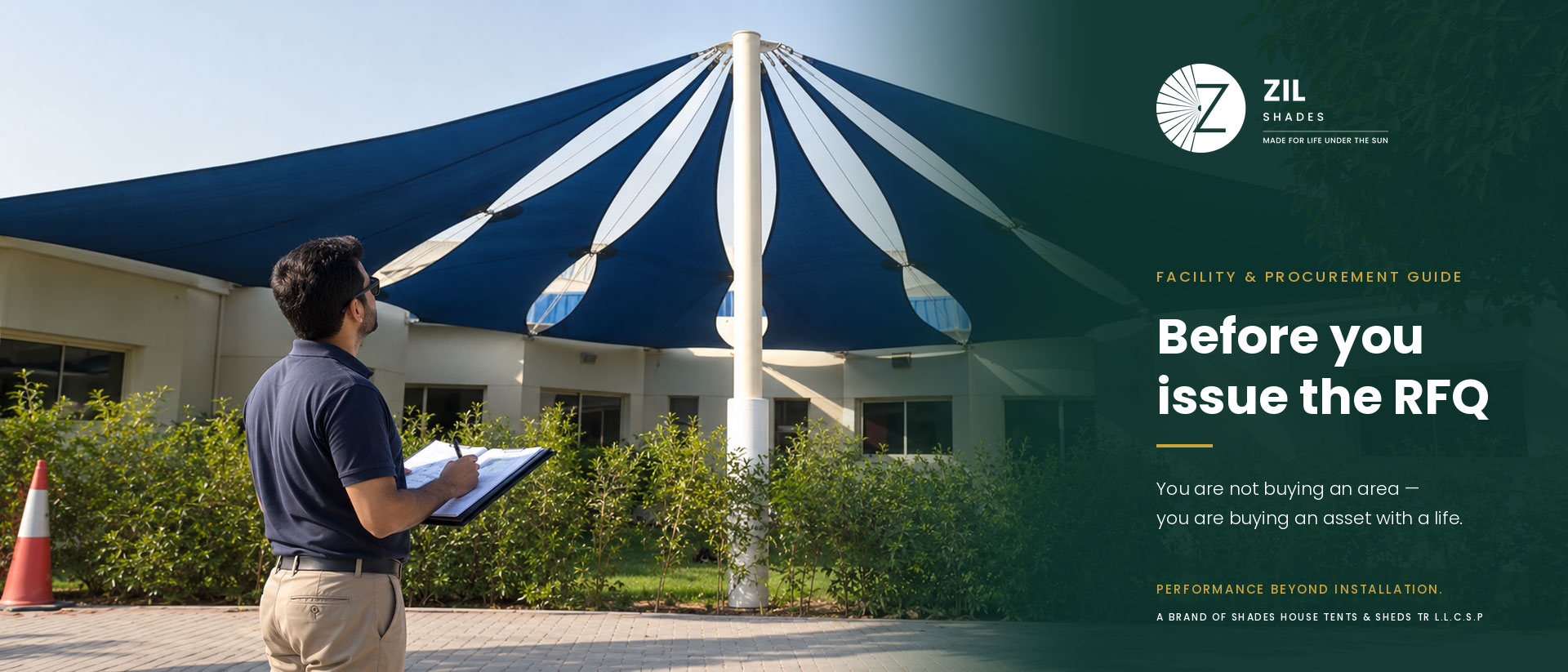
Facility & procurement buying guide

For facility, property and procurement professionals

A framework for defining requirements, preparing RFQs, evaluating proposals and considering risk, engineering, maintenance and lifecycle cost — including why the lowest initial price is frequently not the lowest cost of ownership.

  • Defining the requirement before inviting prices
  • What belongs in an RFQ, and what is usually missing
  • Comparing proposals that are not comparable
  • Structural responsibility — who carries it
  • Wind, rain and the consequences of poor design
  • Lifecycle cost, maintenance and refurbishment planning
  • Risk, operational importance and consequence of failure

Preparing an RFQ right now? Ask the assistant →

03
ZIL Shades Material Guide

Material guide

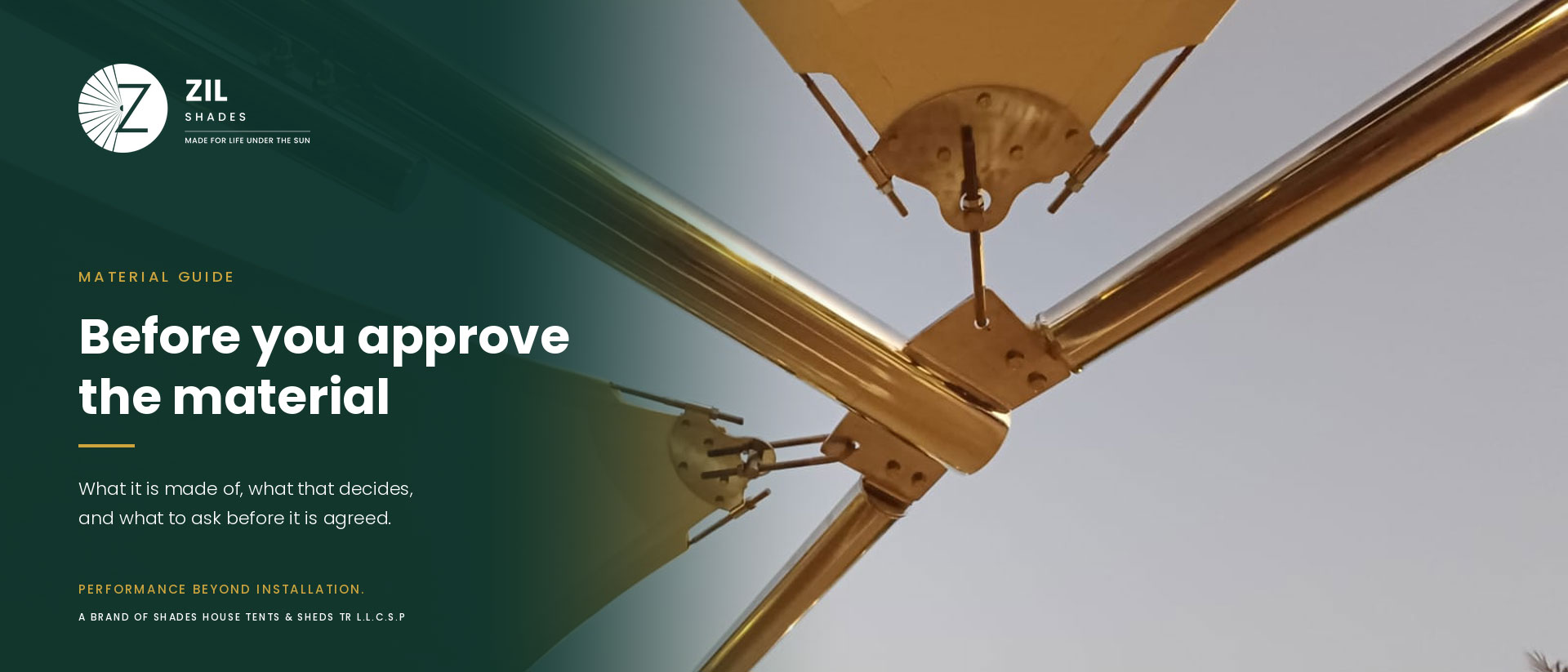
Understand what sits behind the finished structure

A reference to structural materials, fabrics, membranes, coatings, corrosion protection and long-term performance — written to make the point that materials should not be chosen on appearance or initial cost.

  • Structural steel, aluminium and stainless grades
  • Membranes compared honestly — HDPE, PVC, PVDF, PTFE
  • Coatings, corrosion protection and why coatings fail first
  • Fasteners, connections and compatibility
  • Coastal, inland and industrial exposure
  • Performance limits, and what each material cannot do

Materials are one part of long-term performance. Maintenance & lifecycle guide →

04
ZIL Shades Material Guide

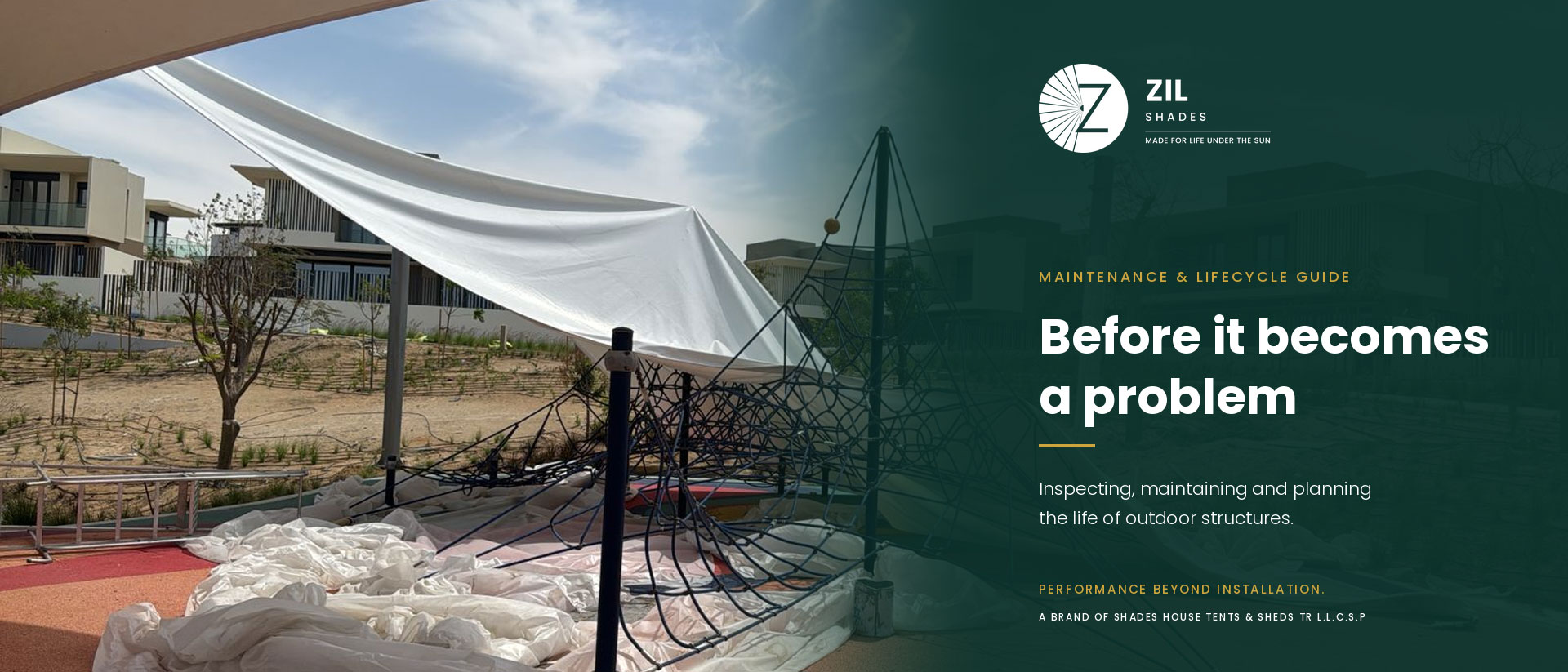
Maintenance & lifecycle guide

Because installation is the beginning, not the end

Inspection, preventive maintenance, cleaning, condition monitoring, repair, refurbishment, replacement planning and asset records — written so you can hold any contractor to it, not only us.

  • What to look at yourself, and how often
  • Warning signs that are structural, not cosmetic
  • What a maintenance visit should actually contain
  • When to repair, when to refurbish, when to replace
  • Ageing, environmental exposure and what accelerates both
  • Asset records that hold up at audit and at handover
  • Planning replacement before it plans itself

Wondering what condition yours is in? Book an inspection →

The assistant

Have a specific question? Start there.

You do not need to read four guides to find one answer. Ask, and you will get the considerations that actually apply — not a product recommendation.

It answers on
  • Awnings
  • Pergolas
  • Car parking shades
  • Tensile structures
  • Materials and coatings
  • Maintenance
  • Existing structures
  • RFQ preparation
  • Budget considerations
  • Permanent vs temporary

The assistant answers from the ZIL Shades knowledge resources. It will help you understand what matters and what to ask. It will not specify a structure, quote a price or assess a condition — those need an engineer and, for anything already standing, a site visit.

ZIL Shades Assistant Outdoor infrastructure knowledge

Typing here opens the full workspace with your question already asked.

Short answers

Four things worth knowing before you buy.

The parts of the guides that matter most, published now rather than held back. Each one also sits behind the assistant, which is where its answers come from.

Note 01 · Wind

Wind does not push a canopy down. It lifts it.

Air moves faster over the curved top of a canopy than under its flat underside. Faster air means lower pressure above, so the structure is pulled upward — and the load lands on the fixings rather than on the beam.

This is why the cheapest structure and the strongest-looking structure are often the same one, and why neither survives. A heavier canopy pulling on the same fixings into the same slab fails in exactly the same place.

  • Bigger and flatter is worse, not better. More area means more lift.
  • Open sides make it worse. Wind that gets underneath has nowhere to go but up.
  • Ask about the fixings before the section sizes. That is where it lets go.

The part that fails is usually the connection, not the beam.

WIND FASTER AIR ABOVE — LOWER PRESSURE NET UPLIFT HIGHER PRESSURE BELOW THIS IS WHERE IT LETS GO
Swipe the diagram →
The structure is pulled upward, and the load lands on the fixings.
Ask a follow-up about wind
Note 02 · Location

Where you are decides most of what you should build.

The same structure, specified correctly, costs meaningfully different amounts on the coast and thirty kilometres inland. Paying coastal prices inland is waste. Paying inland prices on the coast is a repair bill with a delay on it.

SEA SALT CARRIED INLAND, WEAKENING WITH DISTANCE ON THE COAST NEAR THE COAST INLAND INDUSTRIAL
Swipe the diagram →
Where the boundaries fall is a judgement made at survey, not a fixed distance.
Zone 01

On the coast

Salt spray reaches the structure directly. Chlorides sit on every surface and attack the points where water lingers — joints, bolt heads, weld zones.

ASK ABOUT Stainless grades that resist chloride, sealed connections, and a coating specified for marine exposure.
Zone 02

Near the coast

No direct spray, but salt still arrives on the wind. Corrosion is slower and much less obvious, which is what makes it expensive — it is usually found late.

ASK ABOUT Coating thickness and system, galvanising quality, and how often it should be washed down.
Zone 03

Inland

The enemies are UV, heat cycling and abrasive dust rather than salt. Fabric ages faster than steel, and fixings loosen through daily expansion and contraction.

ASK ABOUT Membrane UV rating, fixing torque checks at each visit, and coating suited to heat rather than salt.
Zone 04

Industrial

Airborne chemicals, exhaust and process residue can be harsher than salt and behave differently. Generic specifications are least reliable here.

ASK ABOUT What is actually in your air, and whether the proposed coating has been used against it before.
Ask about your location
Note 03 · Before you buy

Eleven questions to ask anyone quoting you.

Including us. A contractor who answers these comfortably is worth talking to; one who deflects them has told you something useful for free.

Before anyone gives you a price
  1. 01What exactly are you fixing into, and how do you know it will hold?
  2. 02Where does the water go?
About the structure
  1. 03What wind speed is this designed to withstand?
  2. 04Can I see the calculation?
  3. 05What happens in a storm worse than the design case?
About the materials
  1. 06What grade of steel, and why that grade for my location?
  2. 07What is the coating, and how long does the coating last — not the steel?
  3. 08Which membrane, and what is its rated life here?
About what happens afterwards
  1. 09What does the warranty cover, and what voids it?
  2. 10When should it first be inspected, and what will that cost?
  3. 11If I call you in three years, will you still be here?

Question 11 is blunt, and the most predictive one on the list. A structure outlives most of the companies that install them in this market.

Ask what a good answer sounds like
Note 04 · Premium or standard

When paying more is worth it, and when it is not.

There is no premium option that is right for everyone, and a contractor who recommends the top specification for every job is not specifying, they are selling.

Usually worth it

Spend more when the consequence of failure is high or the access is hard.

  • The structure stands over people who cannot move quickly — a playground, a school walkway, a hospital entrance.
  • You can see the sea from it.
  • Failure would close something that cannot easily close.
  • Getting equipment back to it later would be difficult or expensive.
Usually not worth it

Standard specification is genuinely enough more often than you are told.

  • A domestic awning that spends most of the year retracted.
  • A temporary or seasonal structure with a known end date.
  • An inland site with no salt and no industrial exposure.
  • Where the upgrade is cosmetic and nobody will be close enough to notice.

If you have a fixed budget and have to choose: spend it on the fixings, the connections and the coating, and save it on the fabric. The fabric is the part you can replace in a week.

Ask whether it applies to you
Boundaries

What the assistant does, and what it does not.

Published for the same reason the inspection methodology is published on the Services page: a checkable statement is worth more than a reassuring one.

What it does well
  • Explains what a decision depends on
  • Tells you what to ask, and what a good answer sounds like
  • Compares options and materials impartially
  • Names the resource each answer came from
  • Says when a question is outside what it knows
What it will not do
  • Specify a structure, a section size or a load
  • Quote or estimate a price
  • Assess the condition or safety of anything standing
  • Recommend a ZIL Shades product as the answer
  • Push you toward a quotation
What happens to what you type
  • Nothing identifying you is retained by default
  • No contact details are requested or required
  • Conversations are not attached to a sales record
  • Anonymised questions may be used to improve answers
  • You are never handed to a person without asking

[ To be confirmed against the final platform and UAE data protection review before launch. ]

Next step

Whichever way you came in.

You still have a question

Ask the assistant

Including questions about a structure we did not build, and questions you are asking several contractors at once.

Ask a question
You want it looked at

Book an inspection

The fastest way to find out what condition a structure is really in, and what it needs next.

Book an inspection
You are ready to start

Book a site survey

Measured record, feasibility note, and the products that actually fit your space.

Book a survey
Ask Get a quote